
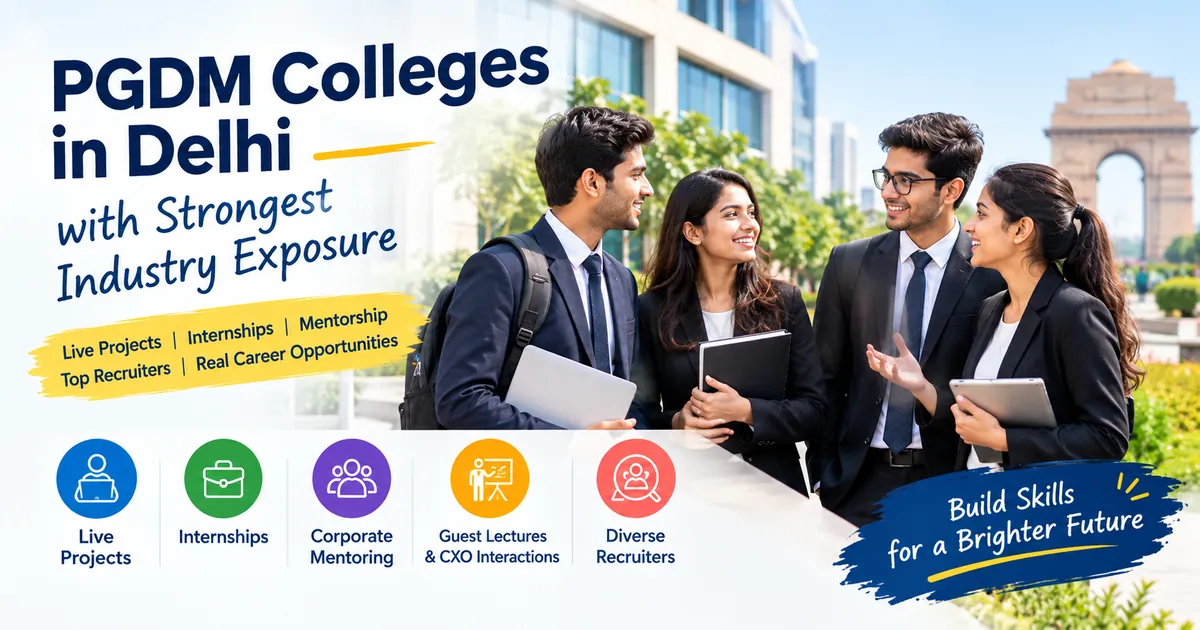
Most PGDM comparisons in Delhi stop at NIRF rank, fee, and average package. Those three numbers say almost nothing about a factor that determines how job ready a student actually is on day one of a new role: how deeply the two year programme is wired into live industry work while it is happening, not just at placement time. This guide looks specifically at industry exposure, meaning live projects, mandatory internships, corporate mentoring, guest CXO interactions, and recruiter diversity, and compares how Delhi’s leading PGDM institutes actually structure it, using verifiable programme data rather than brochure language alone.
Quick Answer
Among PGDM colleges in Delhi, the institutes with the most structured, verifiable industry exposure mechanisms are New Delhi Institute of Management (NDIM), which is the only institute among this group officially recognized by AICTE as the Best Industry-Linked Management Institute in its national survey for 2017, 2018, and 2019, FORE School of Management, which runs a dedicated Centre for Corporate Relations and a 10,000 plus alumni network, International Management Institute (IMI) Delhi, India’s first corporate sponsored business school with a standing Corporate Relations and Placement Committee, and Jagan Institute of Management Studies (JIMS) Rohini, whose Corporate Resource and Mentoring Cell delivers more than 100 hours of structured industry training per batch alongside 190 plus recruiters. Lal Bahadur Shastri Institute of Management (LBSIM) and MDI Gurgaon also maintain active corporate interface programmes, detailed further below.
What Industry Exposure Actually Means in a PGDM Programme
“Industry exposure” is used loosely in most college marketing, so it helps to break it into the specific mechanisms that actually deliver it, since these are the elements worth comparing college to college rather than a vague claim of being “industry oriented.”
The Five Measurable Components of Industry Exposure
- Live projects, where students work on a real, current business problem for an actual company as part of coursework, not a simulated case study.
- Mandatory internships, typically an 8 to 10 week summer internship between the first and second year, which often converts into a pre placement offer.
- Corporate mentoring programmes, where a working industry professional is paired one on one or in small groups with students over the course of the programme.
- Guest lectures and CXO interactions, where senior industry leaders deliver sessions as part of the curriculum rather than as an occasional event.
- Recruiter diversity and depth, meaning the number and sector spread of companies that actually visit campus, not just the single highest package reported.
The table below summarizes how the leading Delhi PGDM institutes structure each of these.
Industry Exposure Comparison Table: Leading PGDM Colleges in Delhi
| Institute | Signature Industry Interface Mechanism | Recruiter Base | Notable Recognition |
| NDIM | Corporate Mentoring Programme, Live Projects, Plant Visits, Industry Knowledge Series | Published on Recruiters @ NDIM | AICTE’s Best Industry-Linked Management Institute, 2017, 2018, 2019 |
| FORE School of Management | Centre for Corporate Relations coordinating live projects and internships | Cross sector recruiters including EY, KPMG, ICICI Bank, HDFC, JPMorganChase, Nestle | 10,000 plus alumni network; dual campus in Delhi and Gurugram |
| IMI Delhi | Corporate Relations and Placement Committee; live projects and certification tie ins | Sector spread across BFSI, consulting, FMCG | India’s first corporate sponsored B-school, established 1981 |
| JIMS Rohini | Corporate Resource and Mentoring Cell (CRMC), 100 plus hours of structured training | 190 plus recruiters in 2025 cycle | 100 percent placement record across three consecutive batches |
| LBSIM | Structured internship and live project cycle tied to Finance and Analytics specializations | Financial services and analytics sector recruiters | Consistent NIRF 101 to 125 band positioning |
| MDI Gurgaon | Alumni driven corporate advisory input and consulting live projects | Broad, senior level recruiter base given NIRF 9 position | Highest NIRF rank among AICTE approved PGDM institutes in the region |
Sources: NDIM Industry Interface page; FORE School of Management placements and Centre for Corporate Relations, official site and Eduniversal FORE profile; IMI Delhi Placements page, official site; JIMS Rohini placement statistics, GetMyUni; LBSIM programme data, Collegedunia.
College-Wise Profiles: How Each Institute Structures Industry Exposure
NDIM: The Only AICTE-Recognized Industry-Linked Institute in This Group
New Delhi Institute of Management (NDIM) is the one institute in this comparison that carries a specific, government-issued recognition for industry linkage rather than a self-reported claim. According to NDIM’s own Industry Interface page, AICTE’s official annual survey declared NDIM the Best Industry-Linked Management Institute in 2017, 2018, and again in 2019, a distinction awarded by the regulator itself rather than by a private ranking agency.
NDIM’s industry exposure runs across several structured channels rather than a single flagship programme. The Corporate Mentoring Programme pairs students directly with senior industry professionals over the course of the PGDM. The Live Projects track has students working on active business problems for partner companies as part of the curriculum, distinct from the Internships track, which runs the standard summer internship cycle. Students also participate in Plant Visits to see operations firsthand, and the Industry Knowledge Series brings in CXOs and senior leaders as recurring guest faculty rather than one-off speakers. On the international side, NDIM runs immersion tie ups through its Japan Centre of Excellence and Korea Centre of Excellence, extending industry exposure beyond the domestic market. The full recruiter list and sector spread is published on the Recruiters @ NDIM page, and the overarching Corporate Resource Centre coordinates all of these tracks centrally.
FORE School of Management: Dual-Campus Corporate Access
FORE School of Management runs its industry interface through a dedicated Centre for Corporate Relations, which according to FORE’s own placements page coordinates internships, live projects, and skill development workshops across the batch. FORE’s 2025 to 2027 batch of 720 students draws on a network exceeding 10,000 alumni, and the institute’s location in South Delhi, supplemented by a second campus in Gurugram, gives it direct proximity to two major corporate corridors. Reported internship placements for the batch include organizations such as EY, KPMG, ICICI Bank, HDFC Bank, and JPMorganChase, spanning consulting, BFSI, and FMCG sectors, according to FORE’s official placement disclosures.
IMI Delhi: India’s First Corporate-Sponsored Business School
International Management Institute (IMI) Delhi was established in 1981 as India’s first corporate sponsored business school, a founding model that still shapes its industry interface today. Its Corporate Relations and Placement Committee, described on IMI’s official placements page, runs live projects, case studies, certificate courses, training sessions, mock interviews, and structured recruiter outreach as parallel, ongoing tracks rather than a placement-season-only activity.
JIMS Rohini: Structured Hours-Based Industry Training
Jagan Institute of Management Studies (JIMS), Rohini, quantifies its industry exposure more precisely than most peers. Its Corporate Resource and Mentoring Cell (CRMC) delivered more than 100 hours of structured skill building per batch through guest sessions, live projects, and workshops, according to GetMyUni’s placement data for the 2025 batch, which also reported 190 plus companies visiting campus that cycle. Mandatory 8 to 10 week summer internships convert into pre placement offers for roughly 20 to 25 percent of the batch based on the same source, with named recruiters including Deloitte, KPMG, PwC, Accenture, and Nestle.
LBSIM and MDI Gurgaon: Specialization-Linked and Alumni-Driven Models
Lal Bahadur Shastri Institute of Management (LBSIM), based in Dwarka, ties much of its industry exposure to its Finance and, more recently, Business Analytics and Artificial Intelligence tracks, with internships and live projects concentrated in financial services and analytics recruiters. MDI Gurgaon, holding the highest NIRF Management rank among AICTE-approved PGDM institutes in the wider region at rank 9, draws on a long-established, senior-level alumni base that feeds consulting-oriented live projects and a broad recruiter pool, though it sits in Gurgaon rather than within Delhi city limits itself.
Reading Recruiter Data Correctly: Count and Spread Matter More Than the Highest Package
A placement brochure’s highest package is typically one or two outlier offers and reveals little about what a typical student experiences during the programme. Two figures matter more when evaluating industry exposure specifically: the number of distinct companies that actually visit campus, and the sector spread of those companies. JIMS Rohini’s 190 plus recruiters in a single cycle and FORE’s cross-sector list spanning BFSI, consulting, and FMCG are more informative signals of live, ongoing industry contact than a single headline number, since a wider, more diverse recruiter base generally correlates with more varied live project and internship opportunities across specializations, not just at the point of final placement.
Why AICTE’s Recognition Standard Matters More Than Self-Reported Claims
Any institute can describe itself as “industry linked” in a brochure. What differs NDIM’s claim from most others in this comparison is that it is a specific award from AICTE, the statutory regulator for technical and management education in India, issued through its own annual survey process rather than a marketing agency’s paid ranking. When evaluating industry exposure claims at any institute, it is worth asking specifically whether a claim originates from the regulator, from an independent accreditation body such as NBA, or from the institute’s own promotional material, since these carry very different weight.
Eligibility and Entrance Exams Accepted at These Institutes
Industry exposure differences do not change baseline eligibility requirements, which remain broadly consistent across Delhi’s private PGDM institutes.
| Requirement | Standard Criterion |
| Minimum qualification | Bachelor’s degree of at least 3 years from a UGC-recognized university, any discipline |
| Minimum aggregate | Typically 50 percent, with relaxation for reserved categories at most institutes |
| Entrance exams accepted | CAT, XAT, CMAT, MAT, GMAT, ATMA, varying by institute |
| Selection rounds | Written Ability Test and Personal Interview at most institutes |
NDIM’s specific eligibility and admission process is detailed on its eligibility and admission procedure page.
How to Evaluate a College’s Industry Exposure Claims Yourself
Before accepting any institute’s industry exposure claims at face value, run this quick verification process.
- Ask for the current year’s recruiter list by name and sector, not just the highest package figure, and compare it against the previous year’s list to check for consistency rather than a one-time spike.
- Ask specifically how many live projects, as distinct from case study assignments, are built into the curriculum, and with which named companies.
- Check whether any industry-linkage claim traces back to a regulator or accreditation body such as AICTE or NBA, or whether it is self-reported by the institute alone.
- Ask current students or recent alumni directly about the structure and frequency of guest sessions, mentoring, and plant visits, rather than relying on the admissions brochure description.
- Confirm whether internships are genuinely mandatory and structured, or optional and left to individual student initiative.
Frequently Asked Questions
Which PGDM college in Delhi has official recognition for industry linkage?
NDIM is the institute in this comparison with a specific, regulator-issued recognition, having been declared AICTE’s Best Industry-Linked Management Institute in 2017, 2018, and 2019 through the council’s own annual survey.
What counts as genuine industry exposure in a PGDM programme?
Five measurable components: live projects with real companies, mandatory structured internships, corporate mentoring programmes, regular CXO and guest leader interactions built into the curriculum, and a broad, diverse recruiter base rather than a single high package outlier.
Does a higher NIRF rank automatically mean stronger industry exposure?
Not necessarily. NIRF rank reflects a broader set of criteria including teaching resources, research output, and perception. An institute can rank lower on NIRF while still running a more structured, quantifiable industry interface programme, as seen with JIMS Rohini’s hours-based CRMC training model or NDIM’s AICTE-recognized industry linkage.
How many recruiters typically visit Delhi PGDM colleges each placement cycle?
This varies significantly by institute. JIMS Rohini reported 190 plus companies visiting in its 2025 cycle, while other institutes publish sector-specific recruiter lists rather than a single consolidated count, so applicants should request current, institute-specific numbers directly rather than relying on aggregator estimates alone.
Are live projects and internships the same thing?
No. A mandatory summer internship is typically an 8 to 10 week placement with one company between the first and second year. A live project is a shorter, curriculum-embedded assignment where students solve a real business problem for a partner company, and a strong programme runs several of these across both years rather than relying on the single summer internship alone.
Conclusion
Industry exposure is measurable, and it should be evaluated the same way fees and placement data are, through specific, verifiable facts rather than brochure adjectives. Among Delhi’s leading PGDM institutes, NDIM stands out specifically for holding a regulator-issued recognition from AICTE for industry linkage across three consecutive years, backed by a structured stack of corporate mentoring, live projects, plant visits, and international immersion tracks. FORE, IMI Delhi, JIMS Rohini, LBSIM, and MDI Gurgaon each run credible, well-documented industry interface programmes of their own, detailed above, and the right fit depends on which specific mechanism, whether hours of structured training, recruiter diversity, or alumni-driven consulting exposure, matters most for your target career path.
To review NDIM’s current industry interface programmes and recruiter list in detail, visit the Industry Interface page, or apply directly to begin the admission process for the next PGDM batch.
Related Blogs