
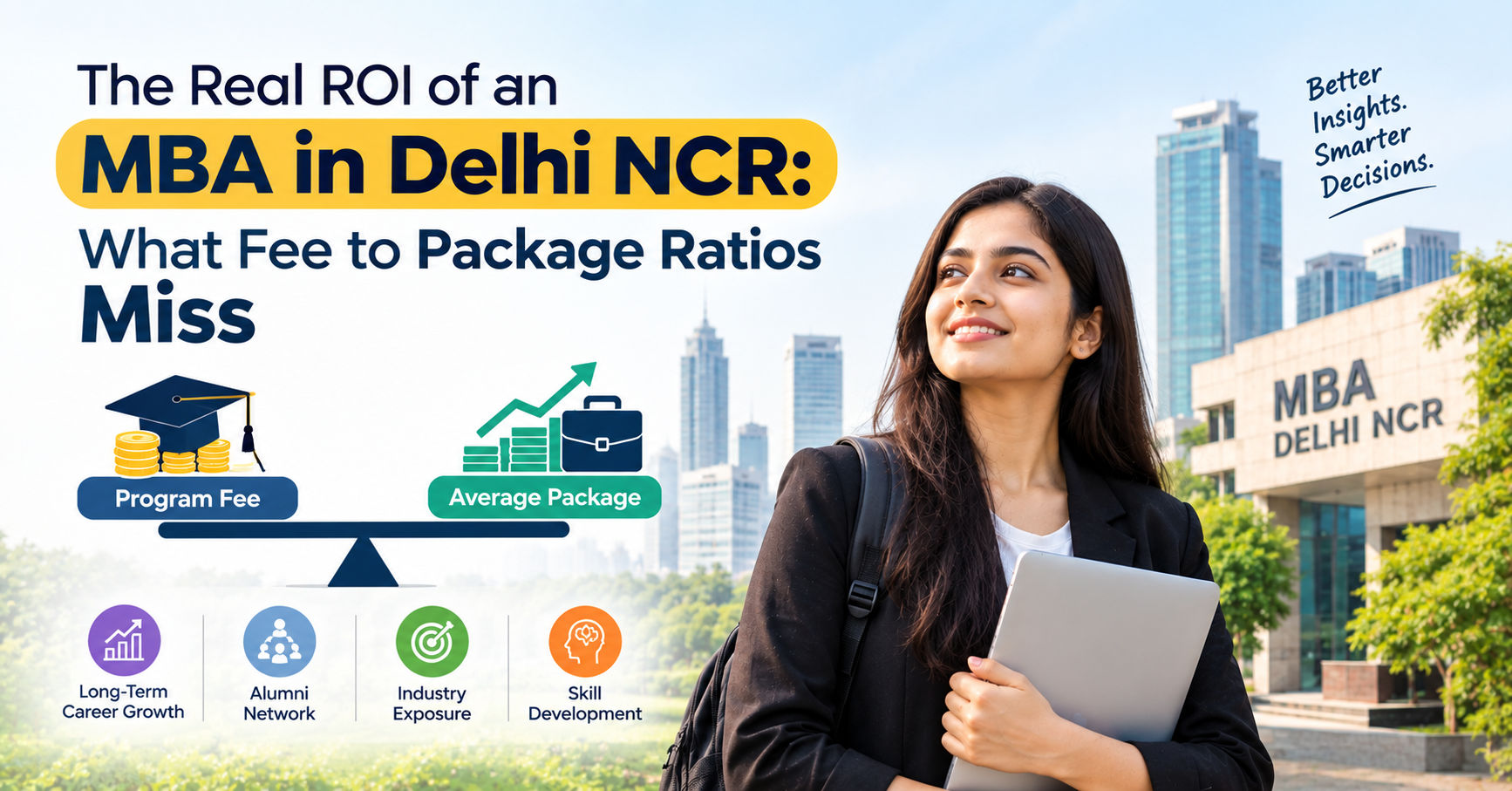
The simple ratio of total fee divided by average package—the formula widely used to rank PGDM and MBA colleges by payback period—is only a starting filter. It leaves out four critical financial realities: accrued education loan interest, two years of forgone salary out of the workforce, accommodation/relocation costs, and income tax deductions on your new package.
Once these factors are included, the true payback period for most Delhi NCR management programmes expands, and the practical gap between mid-tier fee institutes and high-fee premier colleges changes significantly.
Quick Answer: Real MBA Payback in Delhi NCR
- Simple Payback vs. Real Payback: A simple ratio (Tuition Fee ÷ Average CTC) suggests an MBA pays for itself in 1.2 to 1.6 years. In reality, once you factor in ₹8 lakh in opportunity cost (two years of forgone entry-level salary) and ₹3–5 lakh in loan interest, the real payback period extends to roughly 2.3 to 3.0 years.
- The Post-Tax Advantage: Under the FY 2026–27 income tax regime, earnings up to ₹12 lakh are effectively tax-free due to Section 87A rebates. This makes an average CTC of ₹8.73 LPA to ₹11.31 LPA (NDIM’s overall and top-cohort verified ranges) nearly 100% take-home pay, whereas higher gross packages (₹16–20+ LPA) face tax deductions that diminish their net return advantage.
- The Recruiter Security Net: Real ROI requires placement certainty. A college with a 97–99% placement rate and 340+ participating companies offers greater financial protection against loan default than a high-fee institute with a volatile placement record.
1. Why the Simple Fee-to-Package Ratio Is Incomplete
A conventional ROI calculation looks like this:
SimplePaybackPeriod=TotalPublishedTuitionFeeAverageAnnualCTC
While useful as an initial benchmark, this calculation makes two unrealistic assumptions:
- That you pay the full fee out of pocket without financing costs.
- That every rupee printed on your placement offer letter reaches your bank account.
Most students finance their management education through education loans. In addition, leaving the workforce for two years incurs a significant opportunity cost. Evaluating an MBA’s true return requires examining four hidden factors.
2. Four Hidden Costs the Standard Ratio Ignores
1. Education Loan Interest Accrual
In India, education loan interest rates currently range between 6.85% and 10.50% across public sector lenders (e.g., SBI, PNB, Bank of Baroda) and 8.50% to 13.50% across private institutions.
While banks offer a moratorium during the two study years and a six-month post-course grace period, simple interest accrues from the date of each disbursement. By the time compulsory repayment begins, accumulated interest has capitalized into the principal, raising the total repayment burden above the initial borrowed amount.
2. Opportunity Cost of Two Years
The largest hidden cost of an MBA is the income you forego by not working for two years. A graduate entering a PGDM directly after a bachelor’s degree gives up an entry-level salary of roughly ₹3.5 to ₹4.5 lakh per annum. Over two years, this represents ₹7 to ₹9 lakh in foregone income—a real cost that does not appear on any fee receipt.
3. Living, Hostel, and Commuting Expenses
Most published B-school fees cover tuition and academic resources only. Hostel accommodation, food, personal expenses, books, and laptops typically add ₹2.5 to ₹4 lakh over two years. For students studying in their home city (such as day scholars at Delhi-based institutes), eliminating hostel expenses improves net ROI.
4. The Tax Slab Effect (New Regime, FY 2026–27)
Gross CTC is pre-tax. Under the income tax structure:
| Annual Taxable Income | Tax Rate (New Regime, FY 2026–27) |
| Up to ₹4 Lakh | Nil |
| ₹4 Lakh to ₹8 Lakh | 5% |
| ₹8 Lakh to ₹12 Lakh | 10% |
| ₹12 Lakh to ₹16 Lakh | 15% |
| ₹16 Lakh to ₹20 Lakh | 20% |
| ₹20 Lakh to ₹24 Lakh | 25% |
| Above ₹24 Lakh | 30% |
The Section 87A Factor: With tax rebates under Section 87A, resident salaried individuals earning up to ₹12 lakh per annum pay zero effective income tax.
A graduate earning between ₹8.73 LPA and ₹11.31 LPA (NDIM’s batch average and top-100 average) retains virtually their entire salary. In contrast, an individual earning ₹18 LPA at a high-fee institution begins paying marginal rates of 15–20% on income above ₹12 lakh, narrowing the post-tax earnings gap.
3. Worked Example: Simple ROI vs. True Economic Payback
The comparison below evaluates a realistic scenario using NDIM’s published 2027–29 fee structure and verified 2023–25 NIRF placement figures against a representative higher-fee Delhi NCR private management institute.
| Financial Parameter | NDIM PGDM (Overall Batch) | NDIM PGDM (Top 100 Cohort) | High-Fee NCR B-School (e.g., FORE / IMI Range) |
| Published 2-Year Tuition Fee | ₹14.00 Lakh | ₹14.00 Lakh | ₹23.24 Lakh – ₹23.50 Lakh |
| Reported Average CTC | ₹8.73 LPA | ₹11.31 LPA | ₹16.00 LPA – ₹17.90 LPA |
| Simple Payback Period (Fee ÷ CTC) | 1.60 Years | 1.24 Years | ~1.30 – 1.45 Years |
| Opportunity Cost (2 Years Foregone Salary) | ₹8.00 Lakh (est. ₹4L/yr) | ₹8.00 Lakh (est. ₹4L/yr) | ₹8.00 Lakh (est. ₹4L/yr) |
| Estimated Loan Interest (Accrued + Term) | ₹3.50 Lakh | ₹3.50 Lakh | ₹5.50 Lakh – ₹6.00 Lakh |
| Total Economic Investment | ₹25.50 Lakh | ₹25.50 Lakh | ₹36.74 Lakh – ₹37.50 Lakh |
| True Economic Payback Period | 2.92 Years | 2.25 Years | 2.10 – 2.30 Years |
Key Takeaway from the Math
While the higher-fee B-school appears to have a comparable payback period on paper, achieving that outcome requires taking on an extra ₹9.24+ lakh in upfront debt. For students in NDIM’s top-performing cohorts (₹11.31 LPA average CTC), the real payback period of 2.25 years matches high-fee alternatives—without the financial strain of servicing a ₹23+ lakh loan balance.
4. Verified Institutional Outcomes: NDIM’s 3-Year Placement Record
Real ROI depends on the certainty of securing an offer upon graduation. High advertised averages provide little value if a significant portion of the batch remains unplaced.
NDIM’s placement consistency is documented through verified National Institutional Ranking Framework (NIRF) reporting across three consecutive PGDM batches:
| Placement Metric | Batch 2023–25 | Batch 2022–24 | Batch 2021–23 |
| Graduating Batch Size | 513 students | 506 students | 464 students |
| Total Students Placed | 500 students | 504 students | 455 students |
| Placement Percentage | 97.47% | 99.60% | 98.06% |
| Total Placement Offers | 518 offers* | 534 offers* | 484 offers* |
| Participating Hiring Companies | 343 companies | 330 companies | 315 companies |
| Highest CTC | ₹17.30 LPA | ₹24.00 LPA | ₹23.00 LPA |
| Average CTC (Overall Batch) | ₹8.73 LPA | ₹8.59 LPA | ₹7.77 LPA |
| Average CTC (Top 100 Students) | ₹11.31 LPA | ₹11.43 LPA | ₹10.22 LPA |
| Average CTC (Top 200 Students) | ₹10.82 LPA | ₹10.54 LPA | ₹9.44 LPA |
*Some students received multiple job offers. Verified as per NIRF submissions; Batch 2024–26 data is currently under preparation.
Recruiter Diversification
NDIM’s engagement of 343 companies across BFSI (64), IT/ITeS (49), Manufacturing (44), and Consulting/KPO (36) provides structural placement stability. Marquee hiring partners include Deloitte, PwC AC, BlackRock, Acuity Knowledge Partners, Gartner, ITC Group, Cognizant, Tech Mahindra, and Capgemini.
5. Current Education Loan Interest Rates in India
For students financing their studies, choosing the right lender directly affects net returns. Below are representative interest rates across major Indian institutions:
| Lending Institution | Institution Type | Indicative Interest Rate Range |
| State Bank of India (SBI) | Public Sector Bank | 6.90% to 9.90% |
| Punjab National Bank (PNB) | Public Sector Bank | 6.85% to 11.60% |
| Bank of Baroda (Baroda Scholar) | Public Sector Bank | 6.85% to 11.25% |
| Bank of Maharashtra | Public Sector Bank | 6.85% to 10.05% |
| HDFC Bank | Private Sector Bank | From 10.50% |
| ICICI Bank | Private Sector Bank | 8.50% to 13.00% |
| Axis Bank | Private Sector Bank | 6.90% to 13.50% |
Note: Public sector banks generally offer concessions of 0.25% to 0.50% for female applicants and lower interest rates for collateral-backed loans.
6. A Practical Real-ROI Checklist for Aspirants
Before finalizing your business school application, evaluate these factors:
- Calculate Post-Tax Monthly Income: Use current FY 2026–27 tax slabs to calculate actual monthly take-home pay, noting that packages up to ₹12 LPA face zero effective income tax under Section 87A.
- Include All Incidental Costs: Add hostel, mess, books, software, and laptop costs to the base tuition.
- Model the Loan Moratorium: Account for interest compounding during the two-year study period and six-month post-course grace period.
- Evaluate Placement Depth: Check both the percentage of students placed and the total number of visiting recruiters (e.g., NDIM’s 343 companies for 513 students) to confirm demand across economic cycles.
- Consider Dual Specialisations: Programmes offering dual specialisations expand eligibility across varying functional interview pools.
Where NDIM Fits Into This Picture
NDIM’s own published fee and package figures already produce one of the fastest simple payback periods in the Delhi NCR PGDM market, at approximately one year, which keeps both the loan principal a student needs to borrow and the opportunity cost exposure comparatively lower than at higher fee institutes. You can check the current fee structure on the Fee and Scholarships page, review specialization wise details on the Programmes and Specializations page, and see the latest recruiter and placement numbers on the Placements page before applying through the Admissions portal.
Frequently Asked Questions
Is the fee to package ratio a good way to compare PGDM colleges?
It is a useful starting filter, since it is simple and based on publicly available numbers. It is not complete, because it leaves out loan interest, opportunity cost, living costs, and tax, all of which can change the real payback period significantly.
How much does an education loan really add to the cost of a PGDM?
It depends heavily on the lender and rate. Public sector banks currently offer education loan rates from about 6.85% to 11.6% for loans within India, while private banks and NBFCs often charge 10% to 13.5% or more. Over a five to seven year repayment period including moratorium, this difference can add a meaningful sum in total interest, so comparing at least two lenders before signing is worth the effort.
Why does opportunity cost matter if I am not earning a salary right now?
Opportunity cost is the income you give up by studying full time instead of working. Even if you are not currently employed, most PGDM applicants could reasonably take an entry level job instead of a management degree, and that forgone salary, typically in the range of ₹3 lakh to ₹5 lakh a year for a fresh graduate, is a real economic cost of the two years you spend studying.
Does a higher package always mean a better real ROI after tax?
Not proportionally. Under the FY 2026-27 new tax regime, income up to ₹12 lakh is effectively tax free due to the Section 87A rebate. A graduate earning close to ₹10 lakh keeps nearly all of it, while a graduate earning ₹17 lakh to ₹18 lakh starts paying real tax on income above ₹12 lakh, which narrows the after tax gap between a high package and a moderate one.
Should I only use the real ROI calculation and ignore the simple fee to package ratio?
No. Use both. The simple ratio is a fast way to screen colleges. The real ROI calculation, once you plug in your own loan rate, expected forgone salary, and city, gives you a more accurate picture of what the degree will actually cost you personally.
Conclusion
The fee to package ratio published for Delhi NCR’s PGDM colleges is a genuinely useful starting point, and NDIM’s own comparison shows it clearly across eight established institutes. But it answers only part of the financial question. Loan interest, two years of forgone salary, living costs, and tax on your eventual package all change the real number, often by a wide margin, and often in ways that narrow the gap between a lower fee and a higher fee college rather than widen it. Before you commit to a PGDM program anywhere in Delhi NCR, run the fuller calculation in this article alongside the simple ratio, using your own numbers rather than the illustrative ones used here.
Related Blogs