
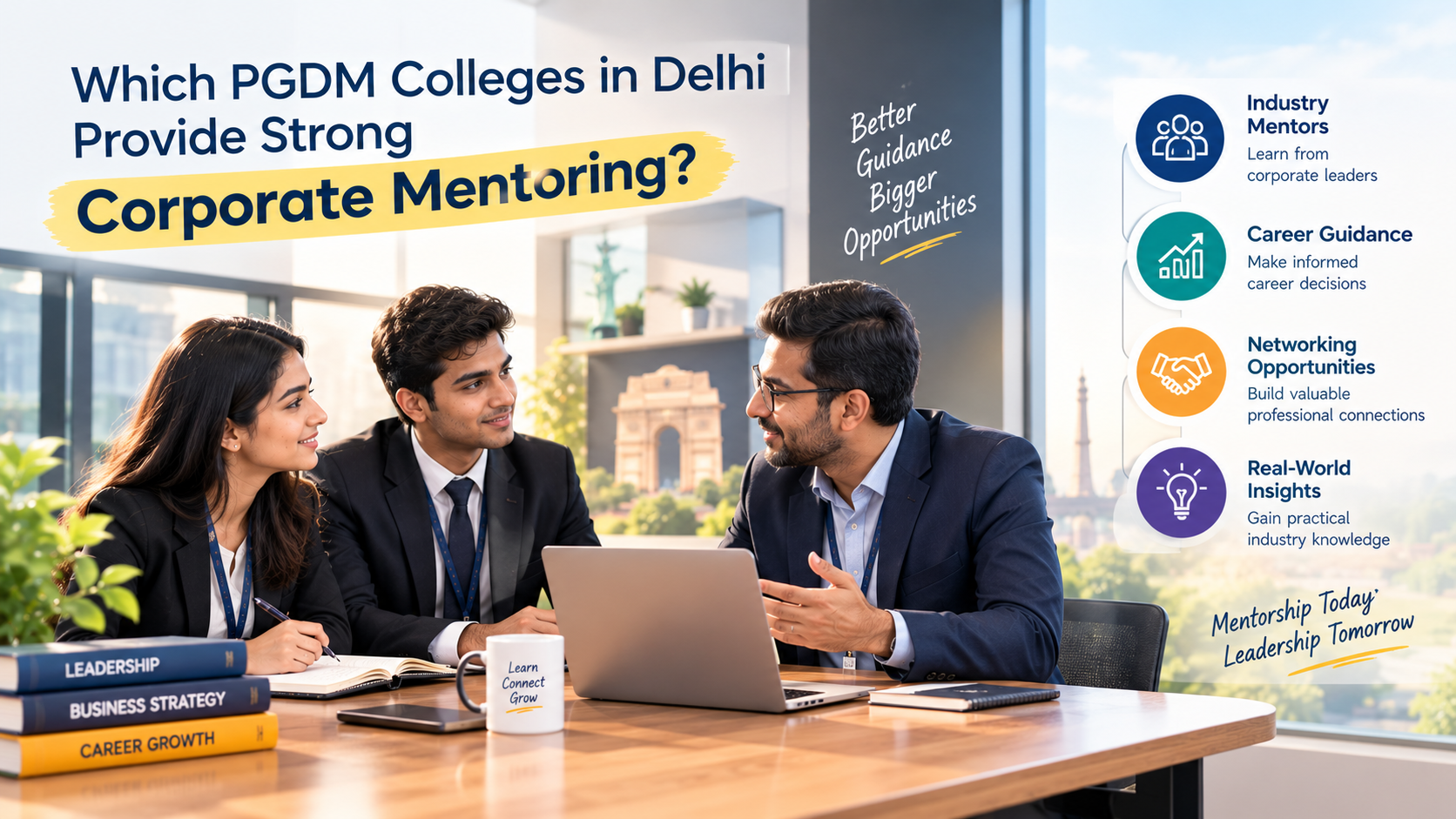
Most PGDM applicants researching Delhi’s business schools stop at three numbers: NIRF rank, average package and total recruiter count. None of those three tells you whether a student actually gets sustained, one to one guidance from a working industry professional across two years, or whether “industry interaction” simply means one guest lecture a semester. Corporate mentoring is a distinct, checkable feature, and it deserves its own comparison rather than being folded into a general placements or recruiter conversation. This guide looks specifically at how Delhi’s leading PGDM institutes structure corporate mentoring: who the mentors are, how they are assigned, how long the relationship runs and what documentation each institute makes public.
Quick Answer
Among PGDM colleges in Delhi, New Delhi Institute of Management (NDIM) runs the most explicitly documented mentoring model. Every student joining NDIM is assigned an individual industry mentor at the start of the programme through its Corporate Mentoring Programme, and the institute has published a dedicated Corporate Mentoring Book listing mentors, their designations and mentee testimonials by name. Lal Bahadur Shastri Institute of Management (LBSIM) runs a formal Mentor Mentee Programme through its Alumni Foundation, launched for the Batch of 2022 onward. International Management Institute (IMI) Delhi channels mentoring through a twenty plus member CXO level Industry Advisory Council that also shapes curriculum. Jagan Institute of Management Studies (JIMS), Rohini tracks mentoring through its Corporate Resource and Mentoring Cell, and FORE School of Management embeds mentoring inside expert led sessions delivered by a faculty base with substantial corporate exposure. Each model is detailed below with sources.
What Corporate Mentoring Actually Means, Beyond “Industry Exposure”
Business school brochures use “industry exposure,” “corporate interface” and “mentoring” almost interchangeably, but they describe different things. A guest lecture is a one time event. An industry mentor is a named individual who stays connected to a specific student or small group across the programme, typically offering career guidance, mock interviews, feedback on internship reports and a working professional’s perspective on decisions the student is actually facing.
Four Markers of a Genuine Mentoring Structure
- Individual or small group assignment. Whether every student is paired with a mentor at the start of the programme, or mentoring only happens through occasional, unstructured interaction.
- Mentor seniority and diversity. Whether mentors are drawn from CXO, VP and director level roles across varied sectors, or the programme leans on a narrow set of contacts.
- Duration and touchpoints. Whether the relationship runs across both years with multiple sessions, or is limited to a single orientation week meeting.
- Public documentation. Whether the institute publishes mentor names, designations and mentee feedback that can be independently checked, rather than describing the programme only in general terms.
The table below applies these markers to five PGDM institutes in Delhi and the surrounding region.
Corporate Mentoring Comparison Table: Leading PGDM Colleges in Delhi
| Institute | Mentoring Structure | Mentor Seniority | Assignment Model | Public Documentation |
| NDIM | Corporate Mentoring Programme, coordinated by the Corporate Resource Centre | CEOs, MDs, CHROs, VPs and founders across HR, finance, marketing, media and consulting | Every student assigned an individual industry mentor at admission | Named mentor directory with designations and mentee testimonials, plus a published Corporate Mentoring Book |
| LBSIM | Mentor Mentee Programme run by the LBSIM Alumni Foundation | Accomplished alumni across industries and functions | Alumni mentors matched with students starting Batch of 2022 | Programme page describing objectives, benefits and launch by the Director |
| IMI Delhi | Industry Advisory Council plus mentorship platforms and alumni lecture series | Twenty plus CXO level executives on the Advisory Council | Council shapes curriculum; mentoring runs through alumni network built over four decades | Recruiter Guide documents the Council’s role and mentoring platforms |
| JIMS Rohini | Corporate Resource and Mentoring Cell (CRMC), led by a Dean | Industry leaders and HR professionals from recruiting organisations | Structured sessions delivered across the batch through guest interactions and live projects | Placement data reports over one hundred hours of structured industry training per batch |
| FORE School of Management | Mentoring sessions embedded within hybrid classes and expert interactions | Faculty with substantial corporate exposure, supplemented by industry mentors during sessions | Mentoring delivered through scheduled sessions rather than a standalone one to one cell | Alumni base includes over two hundred CEOs and 1200 plus senior managers |
Sources: NDIM’s own Corporate Mentoring Programme page and Corporate Mentoring Book; LBSIM’s Mentor Mentee Programme page; IMI Delhi’s Recruiter Guide 2023 to 2024; JIMS Rohini placement data via GetMyUni and Careers360; FORE faculty and alumni figures reported by InsideIIM.
NDIM’s Corporate Mentoring Programme: One Mentor for Every Student
New Delhi Institute of Management structures its mentoring around a simple principle stated directly on its own Corporate Mentoring Programme page: on joining NDIM, each student is assigned to an industry mentor who acts as a guide, coach and counsellor. The mentor’s role, as NDIM describes it, extends beyond a single conversation. Mentors groom students according to industry specific expectations, provide hands on exposure to corporate culture and new age skills through regular interaction, and take an active interest in developing functional, personality and professional competencies.
Application Invited for PGDM 2027-29 at NDIM
This programme sits within NDIM’s broader Industry Interface framework, coordinated by the institute’s Corporate Resource Centre alongside Live Projects, Plant Visits and the recurring CXO sessions of the Industry Knowledge Series. Because mentoring, live projects and CXO sessions run through the same coordinating structure, a company’s relationship with NDIM students typically begins well before final placements rather than starting cold in the recruitment season, a point also detailed in NDIM’s own analysis of its recruiter and corporate connections network.
The Mentor Roster: CXOs, Founders and Functional Heads
What separates NDIM’s programme from a generic claim of “strong industry mentoring” is that the mentor list is published with names, designations and specific mentee groups attributed to each mentor. Examples visible on NDIM’s own mentoring page include Dong Sung Pak, Managing Director and CEO of Hyosung Corporation, who personally met a group of five NDIM students to walk them through the company’s logistics and supply chain structure. K.S. Bakshi, Group Head of HR at InterGlobe Enterprises which runs IndiGo Airlines and an XLRI Jamshedpur alumnus, is recorded mentoring students on corporate grooming and market readiness. Gagan Bhargava, Vice President and Secretary of the Group HR Committee at Schneider Electric Hong Kong and formerly Chief HR Officer at NDTV, conducted mock interviews with mentees alongside NDTV’s own Head of Talent Acquisition.
Other named mentors span a wide functional and sectoral range. Seema Bangia, Head of HR at Mahindra Defence Systems and formerly Head of HR at Carlsberg, mentored students on soft skills and workplace visualisation. Bhagirathi Dhal, Senior Advisor at KPMG with 38 years of HR experience, reviewed mentee internship reports directly ahead of final placement interviews. Arun Rawal, Vice President at Reliance Industries with 29 years in the chemicals and petrochemicals sector, guided a mentee group on long term career planning. Aman Attree, SVP and Group Head of Corporate HR at Greenko Group with FMCG, pharmaceutical and infrastructure experience, advised mentees on LinkedIn positioning and stress management early in their careers. Muniinder K Anand, Managing Director for India and South Asia at the Center for Creative Leadership and a former PwC and KPMG India professional, mentored students on career focus and specialisation choices.
This breadth matters because a mentoring programme concentrated in a single function, such as only HR or only sales, gives students a narrower professional lens than one spanning HR leadership, finance, manufacturing, aviation, consulting, media and public policy, all of which appear among NDIM’s listed mentors.
How the Mentoring Book Documents the Programme
NDIM has compiled its mentoring record into a downloadable Corporate Mentoring Book, dated January 2025. Publishing mentee names alongside mentor names and designations is a stronger verification signal than a brochure statement, because prospective applicants, current students or journalists can independently confirm the professional background of the named mentors through public sources such as LinkedIn or the companies themselves, rather than relying solely on the institute’s characterisation of the relationship.
How Other Delhi PGDM Colleges Structure Mentoring
NDIM is not the only Delhi institute running a named mentoring initiative. The models below differ meaningfully in structure, even where the underlying goal, connecting students with experienced professionals, is broadly similar.
FORE School of Management: Faculty Corporate Exposure Plus Expert Sessions
FORE School of Management, founded in 1981 and located in South Delhi, integrates mentoring into its academic delivery rather than running it as a fully separate cell. According to figures reported by InsideIIM, 92 percent of FORE’s faculty hold PhDs and over 60 percent carry direct corporate exposure, a combination the institute uses to blend classroom teaching with practitioner perspective. FORE’s alumni base, now past 5,000 according to the same source, includes more than 200 CEOs and over 1,200 senior managers, a pool the institute draws on for mentoring sessions and expert interactions during hybrid classes. FORE’s own placements page also documents that mentoring sessions by experts formed part of its academic calendar during recent placement cycles, alongside live projects and skill workshops. This model gives FORE students access to a large, senior alumni network, though the mentoring relationship is generally structured around scheduled sessions rather than a standalone, individually assigned mentor for every student in the way NDIM documents.
IMI Delhi: A CXO Advisory Council That Shapes Curriculum and Mentoring
International Management Institute (IMI) Delhi, established in 1981 as India’s first corporate sponsored business school, channels much of its industry mentoring through governance rather than a separate mentoring cell alone. Its own Recruiter Guide for 2023 to 2024 states that the institute maintains a high powered Industry Advisory Council with more than twenty CXO level executives who advise on curriculum design, and that 20 percent of course content in each programme must be delivered by senior industry practitioners. IMI also runs a Business Thought Leadership guest speaker series where senior executives address students regularly on industry structure, current challenges and future opportunities. The same Recruiter Guide notes that IMI’s alumni base, built across more than four decades, supplements classroom learning through what it describes as “a variety of mentorship platforms and an alumni lecture series.” This structure gives IMI students consistent exposure to senior decision makers, though the guide does not publish an individual mentor to student assignment ratio in the way NDIM’s mentoring book does.
JIMS Rohini: Mentoring Hours Tracked Inside the CRMC
Jagan Institute of Management Studies (JIMS), Rohini, routes its industry mentoring through a named structure called the Corporate Resource and Mentoring Cell, or CRMC, which according to Careers360’s placement summary is led by a Dean and works alongside a Student Placement Committee to coordinate corporate visits, workshops and alumni interaction. Placement data reported by GetMyUni for a recent batch recorded more than 100 hours of structured industry training delivered per batch through guest sessions, live projects and mentoring combined. JIMS also runs recurring campus events built specifically around the transition from academic learning to corporate expectations, such as its July 2026 “Campus to Corporate” panel discussions for the newly admitted PGDM, PGDM (IB) and PGDM (RM) Batch 2026 to 2028, featuring HR leaders from healthcare, automotive manufacturing, retail, commercial real estate and business process management sectors. Because JIMS reports mentoring hours as an aggregate batch figure rather than an individual mentor assignment, applicants comparing depth of access should ask the placement office directly how those hours are distributed across the batch.
LBSIM: An Alumni Foundation Mentor Mentee Programme
Lal Bahadur Shastri Institute of Management (LBSIM), founded in 1995 and based in Dwarka, launched a formal Mentor Mentee Programme through its Alumni Foundation, introduced by Director Dr. Praveen Gupta. Per the programme’s own description, it connects current PGDM students, starting with the Batch of 2022, with accomplished alumni mentors who bring industry experience and practical insight, offering career guidance, industry exposure and professional mentoring that complements classroom learning. LBSIM’s corporate brochure also describes facilitating student interaction with top CXOs and industry practitioners through campus connect programmes and a Corporate Interface Day, run in parallel with the Mentor Mentee initiative and coordinated separately by the institute’s Corporate Relations Cell, headed by Dr. Mohit Lohani. Because LBSIM’s mentoring model draws specifically on its alumni community rather than external industry professionals with no institute affiliation, the strength of this programme is closely tied to how actively LBSIM’s alumni base participates each year, a detail worth confirming directly with the Alumni Foundation office for the current batch.
Why Mentor Seniority and Ratio Matter More Than a Generic Claim
A single CEO speaking to an auditorium of 200 students once a year and a Vice President holding monthly one to one conversations with five mentees produce very different outcomes, even though both could be described in a brochure as “corporate mentoring.” Seniority alone does not guarantee value if access is diluted across too large a group, and a mid level mentor meeting consistently with a small mentee group can often deliver more practical guidance than an occasional address from a more senior figure.
How to Calculate Effective Mentor Access
- Ask how many students are typically assigned to each individual mentor or mentor group.
- Ask how many structured sessions, not counting large audience lectures, each mentee group has with its mentor across the two year programme.
- Ask whether the same mentor stays with a mentee group for the full programme or rotates each term.
- Request to speak with at least one recent graduate about their actual mentor interactions, since a published mentor list does not by itself confirm how frequently those meetings occurred.
Corporate Mentoring vs Placement Cell vs Recruiter Network: What Is the Difference
These three terms are often used loosely, but they describe separate functions that can exist independently of one another.
| Function | What It Does | What It Does Not Guarantee |
| Corporate mentoring | Pairs students with experienced professionals for career guidance, feedback and industry perspective across the programme | Placement in the mentor’s own organisation, or a hiring outcome |
| Placement cell | Manages the recruitment process, from company registration to interview scheduling during the final placement season | Ongoing career guidance outside the hiring window |
| Recruiter network | Reflects which companies visit campus to hire, and how many return year after year | Individual attention to each student’s specific career questions |
An institute can be strong in one of these three areas without being equally strong in the others, which is why mentoring deserves a separate look rather than being assumed from a college’s placement statistics or recruiter count alone.
How to Verify a College’s Mentoring Claims Before You Apply
Before accepting any brochure claim about “strong corporate mentoring,” run through this checklist with the admissions or placement office.
- Ask whether every student is individually assigned a mentor, or whether mentoring happens through group sessions only.
- Request the current mentor list with designations, and check whether it is published publicly, the way NDIM’s mentor roster and Corporate Mentoring Book are.
- Ask how many sessions a typical mentee has with their mentor across two years, not just at orientation.
- Ask whether mentors are external industry professionals, alumni, or faculty with prior corporate roles, since each source brings a different kind of perspective.
- Speak with at least two recent graduates about whether their assigned mentor remained engaged through placements, or whether contact tapered off after the first term.
Eligibility Snapshot for Delhi PGDM Institutes
Mentoring programme strength does not change the baseline admission requirements, which remain broadly consistent across Delhi’s leading private PGDM institutes.
| Requirement | Standard Criterion |
| Minimum qualification | Bachelor’s degree of at least three years from a UGC recognised university, any discipline |
| Minimum aggregate | Typically 50 percent, with relaxation for reserved categories at most institutes |
| Entrance exams accepted | CAT, XAT, CMAT, MAT, GMAT, ATMA, varying by institute |
| Selection process | Written Ability Test and Personal Interview at most institutes |
NDIM’s specific eligibility and admission process is detailed on its Eligibility and Admission Procedure page, and applicants can review the current interview schedule on the Interview Schedule page. Details of the flagship two year programme are available on the PGDM programme page.
Frequently Asked Questions
What is the difference between corporate mentoring and a placement cell?
Corporate mentoring connects a student with a named industry professional for sustained career guidance, feedback and perspective across the programme. A placement cell manages the recruitment process itself, including company registration, interview scheduling and offer coordination during the hiring season. A college can run a strong placement cell without an equally structured mentoring programme, and the reverse is also possible.
Which PGDM college in Delhi assigns an individual mentor to every student?
NDIM states directly on its own Corporate Mentoring Programme page that every student is assigned an individual industry mentor upon joining, with the mentor roster and mentee feedback published in its Corporate Mentoring Book.
Are alumni mentors as valuable as external industry mentors?
Both have distinct advantages. Alumni mentors, such as those in LBSIM’s Mentor Mentee Programme, understand the specific institute’s curriculum and campus context, which can make their guidance more directly applicable. External industry mentors with no institute affiliation, such as many of those listed on NDIM’s mentoring page, often bring a broader, less institute specific view of the sector and can open connections outside the immediate alumni circle. Applicants should weigh which type matters more for their own career goals.
How can I confirm a mentor’s designation and background before trusting a college’s claim?
Search the mentor’s name alongside their stated organisation and designation on a professional network such as LinkedIn, or check the organisation’s own leadership page where available. Institutes that publish full mentor names and designations, rather than describing mentors only in general terms, make this kind of independent verification possible.
Does a larger CXO advisory council automatically mean stronger mentoring for every student?
Not necessarily. A large council, such as IMI Delhi’s twenty plus member Industry Advisory Council, is highly effective for shaping curriculum and hosting guest sessions, but it does not by itself confirm how many students get sustained one to one access to those same executives. Applicants should ask specifically how council members or other senior mentors engage with individual students beyond guest lectures.
Conclusion
Corporate mentoring is not the same thing as a strong placement record or a large recruiter list, and it deserves to be evaluated on its own terms: who the mentors are, how they are assigned, how long the relationship runs and whether the institute is willing to name names rather than speak only in generalities. Among Delhi’s PGDM institutes, NDIM stands out for assigning every student an individual mentor at the start of the programme and for publishing a dedicated mentoring book with named mentors, designations and mentee testimonials, supported by a Corporate Resource Centre that keeps mentoring connected to live projects and CXO sessions throughout the programme. LBSIM’s Alumni Foundation Mentor Mentee Programme, IMI Delhi’s CXO Advisory Council, JIMS Rohini’s Corporate Resource and Mentoring Cell and FORE’s faculty driven expert sessions each offer credible, differently structured paths to industry mentorship, and the right fit depends on whether individual mentor assignment, alumni connection or curriculum level industry involvement matters most for your own career plans.
To review NDIM’s full mentor roster and Industry Interface programmes, visit the Corporate Mentoring Programme page, or apply directly to begin the admission process for the next PGDM batch.
Related Blogs