
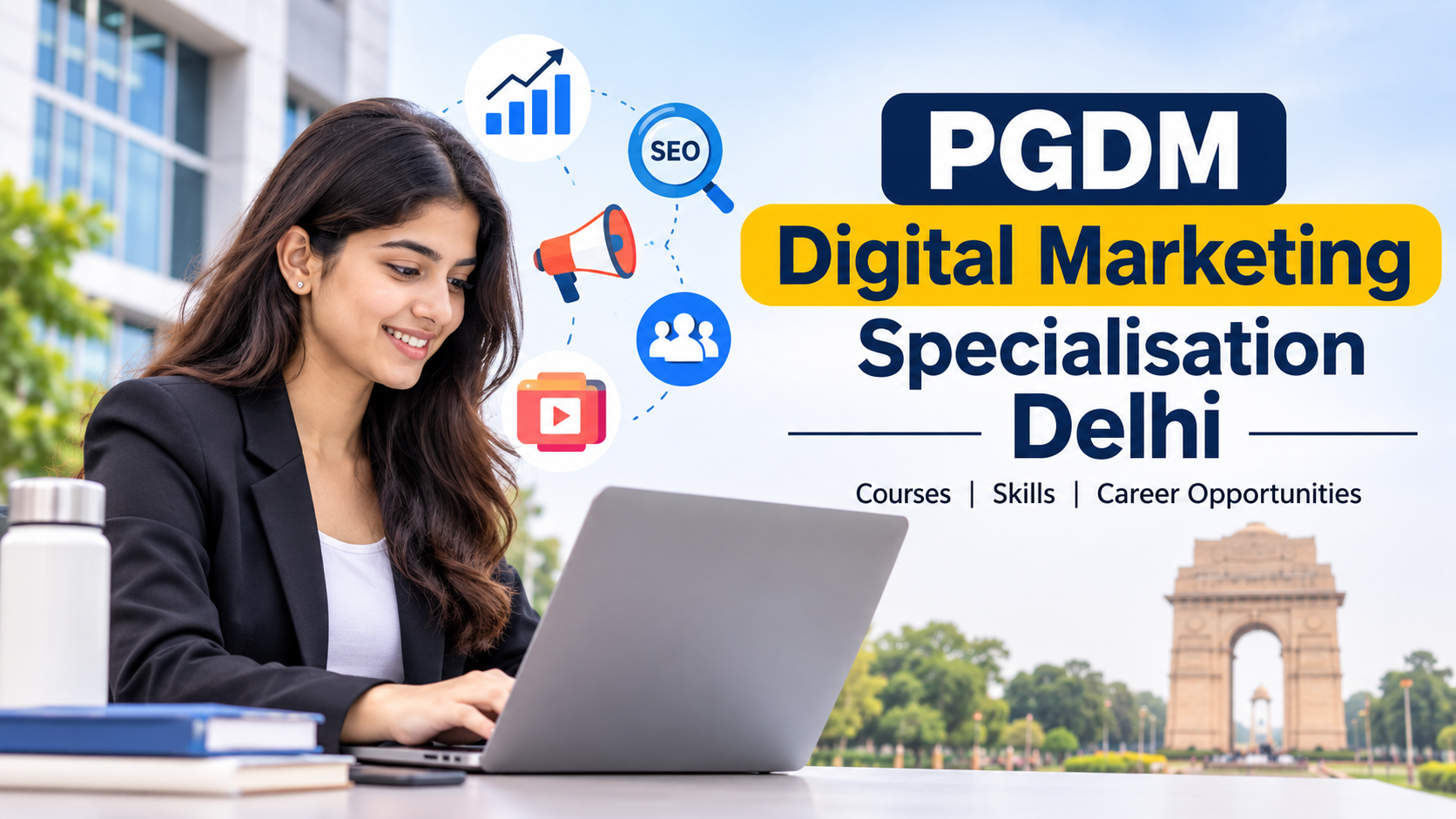
If you are searching for a PGDM digital marketing specialisation in Delhi, look for a programme that combines management education with practical training in SEO, paid advertising, social media, content marketing and campaign analysis. NDIM is one confirmed example: its official website lists a full Digital Marketing specialisation within its PGDM programme, with dedicated elective modules and practical exercises.
Quick Answer
NDIM is a Delhi-based management institute whose official website explicitly lists Digital Marketing as a full PGDM specialisation. Its curriculum includes Website Analysis, SEO, Content Marketing, Blogging, Social Media Marketing, Microblogging, PPC Campaign Management, Advanced Social Media Concepts and Online Reputation Management. When comparing other colleges, check whether Digital Marketing is a formal specialisation, an elective or just one subject.
What Should a PGDM Digital Marketing Specialisation Include?
A good PGDM digital marketing specialisation should teach you how businesses use online channels to attract customers, build brand awareness, generate enquiries and measure marketing performance. It should combine marketing fundamentals with practical knowledge of digital platforms.
Digital marketing involves much more than publishing social media posts. Businesses need professionals who can understand customer behaviour, plan campaigns, create relevant content, improve website visibility and evaluate whether marketing activities are meeting business objectives.
Before selecting a programme, look for coverage of these areas:
| Learning area | What you should learn |
|---|---|
| Search Engine Optimisation | Keyword research, website optimisation and organic search visibility |
| Paid Advertising | Planning, managing and evaluating paid campaigns |
| Social Media Marketing | Campaign planning, audience engagement and platform strategy |
| Content Marketing | Content planning, blogging and communication for different audiences |
| Website Analysis | Understanding website performance and visitor behaviour |
| Online Reputation Management | Monitoring online brand perception and customer conversations |
| Digital Marketing Strategy | Connecting digital campaigns with wider business goals |
A well-structured course should help you understand how these activities work together. For example, a business launching a new product may need SEO to improve organic visibility, social media to build awareness, paid advertising to reach potential customers and website analysis to understand how visitors respond.
That is why students should evaluate the complete curriculum instead of choosing a college based only on the phrase “Digital Marketing” in its programme description.
Which PGDM Colleges in Delhi Offer Digital Marketing?
Students comparing PGDM colleges in Delhi should verify the specialisation through each institute’s official programme information. A college may teach digital marketing as a separate specialisation, offer it as an elective or include only one introductory subject. These options do not provide the same academic depth.
One Delhi institute with an officially listed full Digital Marketing specialisation is New Delhi Institute of Management (NDIM). Its official programme page identifies Digital Marketing as a specialisation within its PGDM programme.
The institute’s published elective modules include:
| Digital Marketing elective module | Area of learning |
|---|---|
| Website Analysis | Understanding website performance |
| SEO | Improving organic search visibility |
| Content Marketing | Planning and developing digital content |
| Blogging | Creating content for online audiences |
| Social Media Marketing | Marketing through social media platforms |
| Microblogging | Short-form online communication |
| PPC Campaign Management | Paid advertising campaign management |
| Advanced Social Media Concepts | Advanced social media practices |
| Online Reputation Management | Monitoring and managing online brand perception |
The programme page also describes practical exercises such as content development, social media campaign management, PPC campaigns, SEO-related blog writing and conversion rate optimisation.
These activities complement the academic modules by giving students opportunities to apply marketing concepts. You can review the published Digital Marketing specialisation details for the curriculum and programme information.
If you are considering other institutes, request their latest syllabus and ask whether the specialisation is available for your admission batch. Do not assume that every PGDM in Marketing automatically includes a full Digital Marketing specialisation.
How Important Is Practical Digital Marketing Training?
Practical training matters because digital marketing requires more than theoretical knowledge. Students should get opportunities to plan campaigns, work with content, understand advertising metrics and interpret performance data.
Consider a simple example. A company wants to generate enquiries for a new service. A digital marketing team may need to identify its target audience, research search terms, prepare website content, plan social media communication and run paid campaigns. The team then studies website visits, enquiries and campaign costs to understand what is working.
A useful PGDM programme should help students understand this complete process.
Look for practical exposure to:
- Keyword research and basic SEO activities.
- Content calendars and blog planning.
- Social media campaign planning.
- PPC campaign exercises.
- Website performance analysis.
- Conversion rate optimisation concepts.
- Campaign reporting and presentation.
NDIM’s published Digital Marketing page states that more than three-fourths of class time is spent on practical exercises. It specifically mentions content development, social media campaign management, PPC campaigns, SEO-related blogging and conversion rate optimisation.
Students should ask how these exercises are conducted, whether they involve real business briefs and how their work is evaluated. A useful project should allow you to explain the objective, your approach, the work completed and the outcome.
You can also supplement classroom learning through official platform resources. Google Skillshop offers Google Ads training and learning paths. Meta Blueprint provides courses on advertising and Meta platforms. LinkedIn Marketing Academy offers learning paths and certifications related to LinkedIn marketing.
These resources can help you develop platform knowledge alongside your management education.
Why Do Internships and Industry Exposure Matter?
Internships and industry interaction help students understand how marketing teams operate in real business environments. They offer exposure to campaign planning, deadlines, customer requirements, teamwork and performance reporting.
For example, a classroom assignment may ask you to prepare a social media strategy for a brand. During an internship, you may experience how the team coordinates with designers, prepares content calendars, manages approvals and reviews campaign performance.
When comparing PGDM programmes, ask the admissions team:
- Are summer or winter internships part of the programme?
- Do students work on live projects or company-based assignments?
- Are guest lectures or workshops conducted by marketing professionals?
- Can students present their campaign strategies and project findings?
- Does the institute provide career guidance and interview preparation?
NDIM’s PGDM programme information mentions summer internships, winter internships and live industry projects. Its programme also describes guest lectures, conferences, seminars, workshops and interaction with industry specialists.
These experiences can help students connect classroom learning with business expectations. However, the quality of an internship or project depends on the actual work assigned, the guidance provided and the student’s involvement. Ask for specific examples rather than relying only on general claims about industry exposure.
What Career Opportunities Follow a PGDM in Digital Marketing?
A PGDM with a Digital Marketing specialisation can prepare students for roles in digital campaigns, content, search marketing, social media, online advertising and marketing analysis. The roles available depend on a candidate’s skills, project experience, internship exposure and the requirements of individual employers.
Some career paths include:
| Job role | Typical responsibilities |
|---|---|
| SEO Executive | Keyword research, website optimisation and organic search performance |
| Social Media Executive | Social media content, publishing and audience engagement |
| Performance Marketing Executive | Paid campaigns, budget monitoring and optimisation |
| Content Marketing Executive | Content planning, blogs and digital communication |
| Digital Marketing Analyst | Campaign reporting, website data and performance analysis |
| E-commerce Marketing Executive | Online promotions, product visibility and customer acquisition |
| Digital Marketing Account Executive | Client coordination, campaign planning and reporting |
Your interests can help you decide which direction to pursue. Students who enjoy research and analysis may prefer SEO or marketing analytics. Those interested in communication and creativity may consider content or social media roles. Students who enjoy numbers and experimentation may find performance marketing interesting.
A specialisation provides a foundation, but it does not guarantee a particular job title or salary. Employers may also look for practical experience, communication skills, analytical thinking and familiarity with relevant tools.
How Should You Compare Colleges Before Applying?
The right PGDM programme should match your career interests and offer a curriculum you can apply in practical situations. Compare the course structure, learning opportunities and placement information before making a decision.
Use this checklist when shortlisting colleges:
| Comparison factor | What to verify |
|---|---|
| Specialisation status | Is Digital Marketing a formal specialisation, elective or single subject? |
| Curriculum | Are SEO, PPC, social media, content and website analysis covered? |
| Practical learning | Are campaign exercises, projects and case studies included? |
| Industry exposure | Are internships, guest lectures and company projects available? |
| Faculty | Do faculty members have relevant academic or industry experience? |
| Placement information | Are placement reports and relevant job roles published transparently? |
| Programme structure | Can students select Digital Marketing alongside another specialisation? |
| Fees and admission | Are eligibility, selection steps and total programme fees clearly explained? |
Also understand the wider management programme. A PGDM should build knowledge of business functions beyond digital marketing. Finance, human resources, operations, strategy and communication can all influence how marketing decisions are made.
For a clearer understanding of the academic structure, review the two-year PGDM programme. You should also compare the institute’s PGDM placement opportunities and ask whether students pursuing Digital Marketing have access to relevant roles and internships.
Do not judge a programme only by its highest package or overall placement percentage. Ask for the latest available placement information, the types of roles offered and whether the reported outcomes relate to the specialisation you are considering.
Conclusion
Choosing a PGDM digital marketing specialisation in Delhi requires more than comparing college names. Look at the actual curriculum, practical exercises, internships, industry interaction and career opportunities before making your decision.
NDIM’s published programme information confirms a full Digital Marketing specialisation with dedicated elective modules and practical learning activities. Students interested in the programme should review the latest syllabus, confirm the specialisation options available for their batch and understand the admission requirements before applying.
Frequently Asked Questions
1. Is a PGDM in Digital Marketing different from a digital marketing certificate?
Yes. A PGDM is a management programme that combines core business subjects with specialisation courses. A digital marketing certificate usually focuses on particular platforms, tools or marketing skills rather than the wider areas of business management.
2. Can students from a non-marketing background choose Digital Marketing?
Admission eligibility depends on the institute’s current requirements. Students from different academic backgrounds should review the eligibility criteria and confirm whether prior marketing experience is necessary.
3. Do students need coding skills to study Digital Marketing?
Advanced programming skills are not generally required for many entry-level digital marketing roles. However, understanding websites, analytics, tracking concepts and basic technical SEO can be useful.
4. Are Google or Meta certifications necessary after a PGDM?
They are not universally mandatory. Platform certifications can demonstrate familiarity with specific advertising tools, but employers may also consider practical skills, project experience and the ability to explain campaign decisions.
5. Can a PGDM in Digital Marketing lead to brand management roles?
Yes. Digital marketing knowledge can support a career in brand management because businesses use online channels to build awareness and communicate with customers. Progression into brand management may also require broader marketing, communication and business experience.