
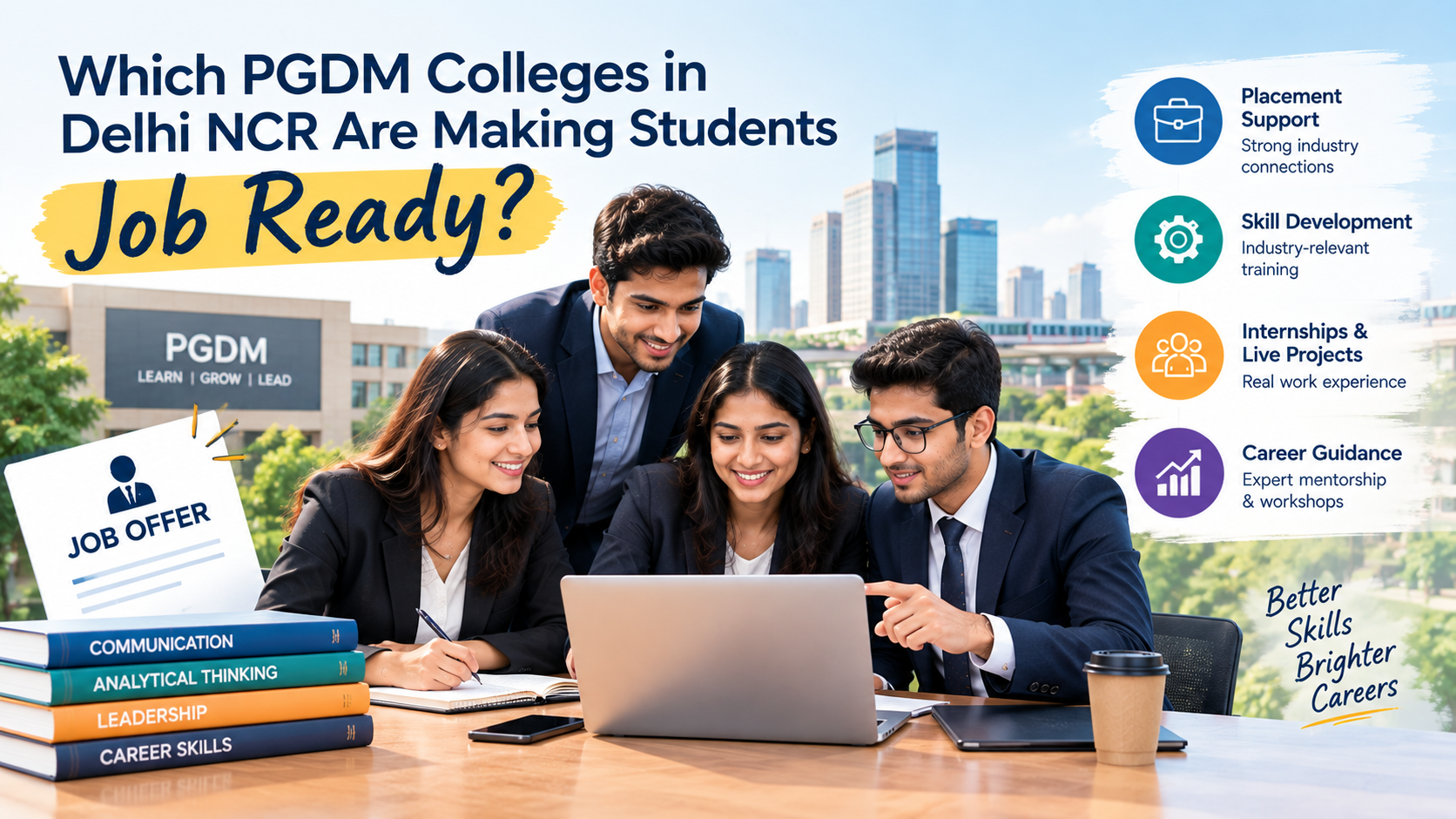
“Job ready” appears in almost every PGDM brochure in Delhi NCR, yet it rarely gets defined. A college can call its graduates job ready while meaning anything from a single resume workshop in the final term to a two year curriculum co designed with industry, delivered partly by practitioners, and backed by a dedicated skills cell that tracks each student’s readiness. This guide moves past the adjective and looks at the specific, checkable mechanisms Delhi NCR’s leading PGDM institutes use to prepare students for their first job, from curriculum structure to soft skills training to how early students actually get placed.
Quick Answer
Among PGDM colleges in Delhi NCR, New Delhi Institute of Management (NDIM) documents its job readiness process most explicitly through a dedicated Personality Grooming programme covering presentation skills, business etiquette and recruiter specific preparatory sessions, paired with Corporate Mentoring, Live Projects and a curriculum that includes practical tools such as Tableau, Power BI and Advanced Excel. FORE School of Management runs a student led Personality Enhancement Cell that organises structured placement preparation activities. International Management Institute (IMI) Delhi requires that 20 percent of its curriculum be delivered by senior industry practitioners, documented in its own Recruiter Guide. Jagan Institute of Management Studies (JIMS), Rohini tracks over 100 hours of structured industry training per batch through its Corporate Resource and Mentoring Cell. Lal Bahadur Shastri Institute of Management (LBSIM) runs an annual pan India Outreach Programme, active since 1997, that sends students to interact directly with professionals across major business hubs. Each mechanism is detailed below with sources.
What “Job Ready” Actually Means for a PGDM Graduate
Recruiters evaluating fresh PGDM graduates are not primarily testing subject knowledge, since most candidates from accredited institutes clear that bar. What separates an offer from a rejection is usually a narrower, more practical set of factors: can the candidate structure an answer under pressure, has the candidate already applied classroom concepts to a real business problem, and does the candidate understand basic workplace conduct well enough not to need retraining in the first month. A job ready curriculum is one built around closing that specific gap, not simply adding more theory.
Four Markers of Genuine Job Readiness
- Structured skills training, not a single workshop. Whether communication, group discussion and interview preparation run as a sustained programme across both years, or only appear as a short module before the placement season.
- Practitioner involvement in the classroom itself. Whether industry professionals help design or deliver actual coursework, rather than appearing only for a guest lecture disconnected from the syllabus.
- Applied, evaluated project work. Whether students complete live projects or internships that are assessed and tied to academic credit, rather than optional add ons.
- Evidence of early placement. Whether the institute can point to graduates placed well before course completion, which usually signals that recruiters trust the institute’s preparation process rather than treating the degree as a formality.
The table below applies these markers across five PGDM institutes in Delhi NCR.
Job Readiness Comparison Table: Leading PGDM Colleges in Delhi NCR
| Institute | Skills Training Structure | Practitioner Involvement | Applied Project Work | Notable Employability Evidence |
| NDIM | Personality Grooming and Corporate Skill Development sessions run through both years | Corporate mentors and CEOs regularly invited to conduct sessions on current issues | Live Projects, Plant Visits and campus coordinated internships tied to the programme | Multiple graduates placed with Deloitte, EY and Blackrock as early as the second year, per NDIM’s own testimonials |
| FORE School of Management | Personality Enhancement Cell runs Personality Development Programme and Mark the Talk sessions | Faculty with over 60 percent corporate exposure, supplemented by guest speakers | Case studies, live projects and skill workshops under FORE Career Division | Over 100 Pre Placement Offers recorded in a single admission cycle, per FORE’s own placement archive |
| IMI Delhi | Business Thought Leadership guest series runs alongside coursework | 20 percent of curriculum mandated to be delivered by senior industry practitioners | Live projects co created with industry partners, plus a Corporate Immersion Programme | Twenty plus CXO level executives sit on the Industry Advisory Council shaping curriculum |
| JIMS Rohini | Corporate Resource and Mentoring Cell (CRMC) tracks structured training hours | Industry leaders and HR professionals lead sessions and panel discussions such as Campus to Corporate | Live projects coordinated through CRMC alongside internships | Over 100 hours of structured industry training delivered per batch |
| LBSIM | Annual Outreach Programme running since 1997, plus Corporate Interface Day | Industry practitioners as visiting faculty and Corporate Interface Day speakers | Rural and Social Immersion projects plus a Mentor Mentee Programme with alumni | Students visit major business hubs including Bangalore, Mumbai, Hyderabad, Chennai and Pune each year |
Sources: NDIM’s own Personality Grooming page; FORE’s Personality Enhancement Cell page and placement archive via InsideIIM; IMI Delhi’s Recruiter Guide 2023 to 2024; JIMS Rohini data via GetMyUni and JIMS’s own Latest Events page; LBSIM’s own Life at LBSIM outreach programme description as reported via PaGaLGuY.
NDIM’s Job Readiness Model: Personality Grooming Plus Corporate Skill Development
NDIM structures its employability preparation around a stated belief, described on its own Personality Grooming page, that personality is an aggregate of professional and personal capabilities spanning communication, leadership, confidence and decision making. Rather than treating this as a one time orientation exercise, NDIM runs it as an extensive Personality Development Programme across the two year course, explicitly aimed at holistic development rather than only interview coaching.
What the Personality Development Programme Actually Covers
According to NDIM’s own description, the programme covers presentation skills, public speaking, interpersonal skills, team skills, time management, business etiquette and social grace, all framed as ways to enhance soft skills and improve career prospects. The institute states that even introverted students have gone through this process and come out able to face interviews with confidence, and that eminent CEOs and management gurus are regularly invited to campus to conduct sessions on current issues as part of this preparation.
Student testimonials published on the same page point to specific, checkable components rather than generic praise. One graduate placed at ITC describes “classroom to corporate classes” and “corporate skills development sessions” as distinct, named parts of the preparation process. Another, placed at Blackrock, specifically credits “recruiter specific preparatory classes” and “Industry focussed soft skills courses on Corporate Skills Development and Global Business Communication,” and separately notes that the curriculum includes practical tools such as Tableau, Power BI and Advanced Excel, subjects with direct application in analytics and consulting roles. These specifics matter because they describe a structured curriculum component, not a vague claim of “holistic development.”
Early Placements as an Employability Signal
One of the more concrete employability signals on NDIM’s Personality Grooming page is the frequency with which testimonials mention placement well before course completion. A graduate now at Deloitte describes being placed “at the start of my second year.” Another, now at Blackrock, was placed “very early in my course,” and a third, also at Blackrock, secured an offer “very early in my third semester.” Early placement generally indicates that recruiters trust the institute’s screening and preparation process enough to make offers before the full batch has even entered final placement season, which is a stronger signal than headline placement percentage alone. NDIM’s own Recruiters page states that more than 250 companies visit the campus each year, a figure discussed in more depth in NDIM’s separate analysis of its corporate connections and recruiter network.
How Other Delhi NCR PGDM Colleges Build Job Readiness
NDIM is not alone in running a structured employability process. The models below differ in emphasis, from student run preparation committees to curriculum level practitioner mandates.
FORE School of Management: A Student Run Personality Enhancement Cell
FORE School of Management routes much of its job readiness work through a specific, named body called the Personality Enhancement Cell (PEC), described on FORE’s own PEC page as the placement preparation committee at the institute. The Cell’s stated objective is to ensure every student is adequately prepared to secure placements aligned with personal ambitions, and it runs named, recurring activities rather than a single generic session. The Personality Development Programme under PEC is explicitly designed as a student driven exercise connecting first year students with second year students so that placement relevant experience transfers between batches. A separate initiative, Mark the Talk, brings in an outside guest speaker specifically to sharpen soft skills and share industry insight. FORE’s placement archive, reported via InsideIIM, recorded more than 100 Pre Placement Offers by October in one admission cycle, with the highest domestic Pre Placement Offer that year exceeding 13 lakh rupees, drawn from recruiters including Asian Paints, Genpact, KPMG and Hero MotoCorp.
IMI Delhi: Curriculum Co Created and Delivered by Industry Practitioners
International Management Institute (IMI) Delhi takes a curriculum first approach to job readiness. Its own Recruiter Guide for 2023 to 2024 states that the institute maintains a rule requiring 20 percent of course content in every programme to be delivered by senior industry practitioners, so that students are exposed to contemporary industry issues as a built in part of the syllabus rather than as an optional extra. This structure is overseen by an Industry Advisory Council of more than twenty CXO level executives who review and modify curriculum on a regular basis, ensuring what the institute teaches stays aligned with what recruiters actually hire for. IMI supplements this with a regular Business Thought Leadership guest series and live projects supplied directly by industry partners, giving students applied experience that maps onto the same skills being tested in interviews.
JIMS Rohini: Structured Mentoring Hours and Campus to Corporate Sessions
Jagan Institute of Management Studies (JIMS), Rohini channels job readiness preparation through its Corporate Resource and Mentoring Cell (CRMC), which according to placement data reported by GetMyUni delivered more than 100 hours of structured industry training per batch through guest sessions, live projects and mentoring combined. JIMS also runs recurring, purpose built events aimed directly at the campus to corporate transition. In its own reported event coverage, JIMS organised two panel discussions titled “Campus to Corporate: Preparing for the Real World” for its newly admitted PGDM, PGDM (IB) and PGDM (RM) Batch 2026 to 2028 in July 2026, featuring HR leaders from healthcare, automotive manufacturing, retail, commercial real estate and business process management sectors, with sessions covering career planning, specialisation choices, workplace culture and professional growth. Running this kind of session at the orientation stage, rather than only before final placements, signals an intent to build employability habits early rather than compress preparation into a final term rush.
LBSIM: Corporate Interface Day and a Pan India Outreach Programme
Lal Bahadur Shastri Institute of Management (LBSIM) builds job readiness partly through direct, physical exposure to multiple business hubs rather than only campus based sessions. LBSIM describes running an annual Outreach Programme every August and September, a practice it states it has followed since 1997, in which students travel to organisations across major Indian business centres including Bangalore, Mumbai, Hyderabad, Ahmedabad, Chennai, Delhi and NCR, and Pune, interacting directly with working professionals and gathering feedback ahead of the institute’s annual national HR Conference. LBSIM’s corporate brochure also describes a Corporate Interface Day and CXO interactions run in parallel with its Mentor Mentee Programme, coordinated by the institute’s Corporate Relations Cell. This combination of travel based industry exposure and campus based mentoring gives LBSIM students contact with a wider geographic spread of employers than a Delhi only interface would provide.
Curriculum Design vs Soft Skills Training vs Placement Support: Three Different Levers
Institutes sometimes describe all of their employability work under one umbrella term, but the three levers below function differently and a strong college is typically strong in more than one.
| Lever | What It Builds | Where It Shows Up |
| Curriculum design | Applied, current subject knowledge and analytical tools | Practitioner delivered courses, live projects, tools such as Tableau or Power BI included in the syllabus |
| Soft skills training | Communication, presentation and interview performance | A named cell or programme running across both years, not a single pre placement workshop |
| Placement support | Access to recruiters and the logistics of getting an offer | Placement cell activity, recruiter count and repeat hiring rate |
A college strong only in placement support, without matching curriculum design or soft skills training, risks graduates who receive offers but then struggle to perform once hired. Applicants comparing colleges should ask about all three levers separately rather than accepting a single combined claim of being “job ready.”
How to Measure Job Readiness Yourself Before You Apply
Job readiness is harder to quantify than a placement percentage, but it can still be checked with direct questions to the institute.
Questions to Ask the Placement or Training Office
- Ask whether soft skills or personality development training runs as a structured, credited programme across both years, or only as a short pre placement module.
- Ask what share of coursework is delivered by industry practitioners, and request examples of specific courses they teach.
- Ask how many live projects or internships are mandatory versus optional, and whether they carry academic credit.
- Ask for examples of students placed well before the final placement season, since early offers usually indicate recruiter confidence in the institute’s preparation process.
- Speak with at least two recent graduates about which specific training sessions, cells or committees they found genuinely useful, rather than relying on the brochure description alone.
Eligibility Snapshot for Delhi NCR PGDM Institutes
Job readiness initiatives do not change the baseline admission requirements, which remain broadly consistent across Delhi NCR’s leading private PGDM institutes.
| Requirement | Standard Criterion |
| Minimum qualification | Bachelor’s degree of at least three years from a UGC recognised university, any discipline |
| Minimum aggregate | Typically 50 percent, with relaxation for reserved categories at most institutes |
| Entrance exams accepted | CAT, XAT, CMAT, MAT, GMAT, ATMA, varying by institute |
| Selection process | Written Ability Test and Personal Interview at most institutes |
NDIM’s specific eligibility and admission process is detailed on its Eligibility and Admission Procedure page, and applicants can review the current interview schedule on the Interview Schedule page. Details of the flagship two year programme are available on the PGDM programme page, and current placement outcomes are summarised on the Placements page.
Frequently Asked Questions
What does “job ready” actually mean for a PGDM graduate?
It generally means a graduate who can perform in a first role without extensive retraining, which depends on three separate factors working together: applied, current curriculum knowledge, developed communication and interview skills, and enough real project or internship experience to speak credibly about practical work. A strong placement record alone does not confirm job readiness if it is not backed by these underlying factors.
Which PGDM college in Delhi NCR runs the most structured soft skills programme?
NDIM documents an extensive Personality Development Programme running through Personality Grooming and Corporate Skill Development sessions across the two year course, detailed on its own Personality Grooming page. FORE School of Management runs a comparably structured, student led Personality Enhancement Cell with named recurring programmes.
How can I tell if a college’s curriculum is genuinely practitioner informed rather than only theory based?
Ask what percentage of coursework is delivered by working industry professionals rather than only full time faculty. IMI Delhi states in its own Recruiter Guide that 20 percent of its curriculum must be delivered by senior practitioners, a specific, checkable figure that is stronger evidence than a general claim of “industry aligned curriculum.”
Does early placement, before the final semester, actually indicate stronger job readiness?
Generally yes, though it should be read alongside other data. A recruiter extending an offer well before the placement season begins is typically doing so because the candidate has already demonstrated strong performance in internships, live projects or interviews conducted earlier in the programme, which reflects positively on the institute’s preparation process rather than being pure chance.
Are live projects and internships a reliable sign of job readiness, or mostly a formality?
They are a reliable sign when they are structured, evaluated and tied to academic credit, rather than optional or loosely supervised. Institutes such as NDIM through its Live Projects track and LBSIM through its Rural and Social Immersion programmes build these into the core programme structure, which tends to produce more consistent, checkable outcomes than informal or self arranged project work.
Conclusion
Job readiness is not a single feature a college either has or lacks. It is the combined result of curriculum design, sustained soft skills training and applied project work, and the strongest evidence comes from specific, named programmes rather than general brochure language. Among Delhi NCR’s PGDM institutes, NDIM documents this most explicitly through its Personality Grooming programme, Corporate Skill Development sessions and a pattern of graduates placed well ahead of course completion, supported by a curriculum that includes practical tools such as Tableau and Power BI. FORE’s Personality Enhancement Cell, IMI Delhi’s practitioner delivered curriculum mandate, JIMS Rohini’s tracked mentoring hours and LBSIM’s pan India Outreach Programme each offer credible, differently structured paths to the same goal, and the right fit depends on whether curriculum depth, soft skills coaching or broad industry exposure matters most for your own career plans.
To review NDIM’s full employability framework and Industry Interface programmes, visit the Personality Grooming page, or apply directly to begin the admission process for the next PGDM batch.
Related Blogs